Women’s Day in China: In celebration of International Women’s Day we compiled some answers to three questions we thought were relevant to international women’s day.
Well, we are a team delivering experiential education, and we try to practice what we preach. We turned to the experiential education cycle in writing this article. Here’s a simple graphic for those of you who don’t know what that is.
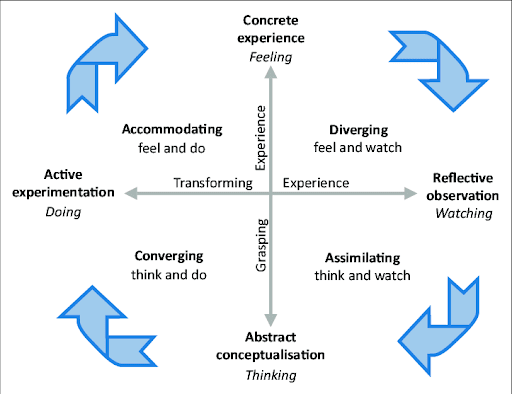
The following are just short snippets of our reflections, thoughts, and commitments on women’s day based on what we’ve learned.
Flowers. Why does everybody celebrate with flowers? Do all women love flowers? Well, we know the flower industry must definitely love women’s day.
After seeing all these responses, we spent some time thinking about why we give women flowers on special occasions such as women’s day, or at all, and we’d like to share the summary of our research. It’s only in the relatively ‘modern’ era that gifting flowers has become ‘feminine’ – you can thank the emotional repressiveness of the Victorian era for that (you’re welcome to google our sources).
Actually, using flowers for ornamentation or gifting goes back to 5000 years ago… In ancient cultures, Chinese, Greek, Egyptian – flowers were associated with ritual, religion, and well, beauty! Do women inherently like flowers, or is that a societal construct? Because guys like flowers too, in certain social constructs. Think about graduation ceremonies.
We also noticed that our oldest colleague seemed to have, what we thought, was the best answer: It’s our women’s day holiday, we should do what makes us happy.
While editing the video we realized that, surprisingly, a lot of us don’t feel like gender inequality exists… Full disclosure, the person writing this article is a woman – hello!
And what we realized is that what we need to take the time to reflect on, as a first step, is that privilege exists. If privilege exists, how can discrimination, not?
The act of recognizing that others are privileged is radical, because it, by default, exposes us to the negative emotions associated with understanding that things aren’t fair; that maybe, we are being discriminated against.
An oversimplified anecdote could be:
You buy something worth 100 USD, but then realizing that someone got the exact same thing for 80 USD. You felt fine and happy when you didn’t know that it was being sold for 80 USD but now you’re thinking about, ‘how come?‘
How can we work within ourselves to feel as fine and as happy as before we found out? To the young women who believe that gender discrimination doesn’t exist. Yes, you might be the exception, but how likely is it that you, and all of your entire group of friends that don’t believe gender inequality exists, are?
Because the statistics don’t lie:
Furthermore, as one colleague mentions in the video, his parents expect women to get married earlier (before 30). As changes come about, generationally, it’s easy to forget that we don’t live in a silo. The ‘older’ generation greatly influences the reality of current modern society. 40 to 79 year olds make up 34.9% of the world’s population and its general opinions.
The cure? Another colleague sums it up. “Think more about each other.” Just putting ourselves in the others’ shoes. When we take the time to think deeply and methodically about another person’s situation, noticing the highlights and shadows of this person’s experiences as they walk through life becomes an automatic byproduct.
In one of our weekly sustainability meetings yesterday the subject of gender equality came up. We realized that we weren’t actively thinking about consciously looking for vendors that were led by women or women owned. Despite over half of our team being women, our founder being a woman, and our director being a woman. What a missed opportunity, and this opportunity was missed because we just didn’t think about it deeply and methodically.
WildChina Education commitments. Let’s do something about it.
We leave you with a quote from one of our colleagues in the video who says:
For women, we just need to say what we want when we are working, don’t [worry about] being too polite, and don’t be afraid to ask more, I think that’s how we can start
Sincerely,
A woman at a workplace, talking about what I want, not worrying about what others might think, asking that we all start together.
© 2026 All rights reserved.
Terms and Conditions